
Longview Previous Resident Sources
Start with the source closest to the period being studied. Current county property data fixes the parcel. Recorded land instruments then supply an ownership chain, while Longview and Kelso directory runs can add a listed household. City permit files date work and identify the role of an applicant or owner. Newspaper and archival sources help bridge gaps. The records below form an era map, not one complete roster of everyone who stayed at a Longview address.
| Longview source | Verified span | Keeper | Evidence supplied |
|---|---|---|---|
| Recorded land index | 1986 to 2026 verified series | Cowlitz County Auditor and Washington Digital Archives | Parties, document type, year, reference, and available image |
| Longview in Kelso directories | Selected years, 1926 to 2012 | Washington State Library | Names and address listings where the volume supplies them |
| Local history and microfilm | Varies by collection | Longview Public Library | Directory, newspaper, obituary, and local-history clues |
| Building and code files | Some archives reach the 1920s | Longview Building Division | Applicant, owner, permit type, dates, and status when shown |
| City and Long-Bell archives | City records include 1923 to 1967 | Washington State Archives | Maps, permits, applications, reports, and local context |
For recent decades, move from the assessor to the deed index. For an early or mid-century Longview house, search the nearest directory editions on both sides of a known event, then ask the library or Archives about maps, microfilm, and permit material. A missing year should stay marked as a gap.
Freeze the Longview Resident Parcel
A street number is easy to mistype and may not survive a split, merger, or changed address style. Search the Cowlitz County Property Search in Address mode. Save the parcel number, site address, owner name, and mailing address exactly as returned. Site, also called situs, means the physical location. The mailing field is where tax mail goes and can point elsewhere.
If the address has more than one unit, the parcel identifies land, not each household. Check the county GIS geometry and note predecessor or successor parcels when the lot changed. That stable parcel reference is the handoff into deeds, plats, and permits. It also guards against attaching previous residents to the wrong Longview lot.
Open the official assessor search before using the address trail. Choose Address, Parcel, or Property ID mode before the backward search begins.
Cowlitz Index Tracks Past Residents
The Cowlitz recorded land series is the verified online route for 1986 through 2026. Its controls include last, first, and middle names, Soundex, party type, document type, an addition keyword, and a year range. Results supply party and document concepts plus a recording reference and an image or order action. The image is the evidence-bearing instrument; the index row is only a finding aid.
Search spelling variants and both party roles. Addition and subdivision words help when the older instrument lacks a modern street address. The Auditor counter at 207 N 4th Avenue, Room 206, Kelso, is the fallback for a missing scan, an unclear index entry, or a record before the online series. Counter hours are Monday through Thursday, 7:00 a.m. to 4:30 p.m.; the verified phone is 360-577-3002.
View the official land-record search and its field choices.
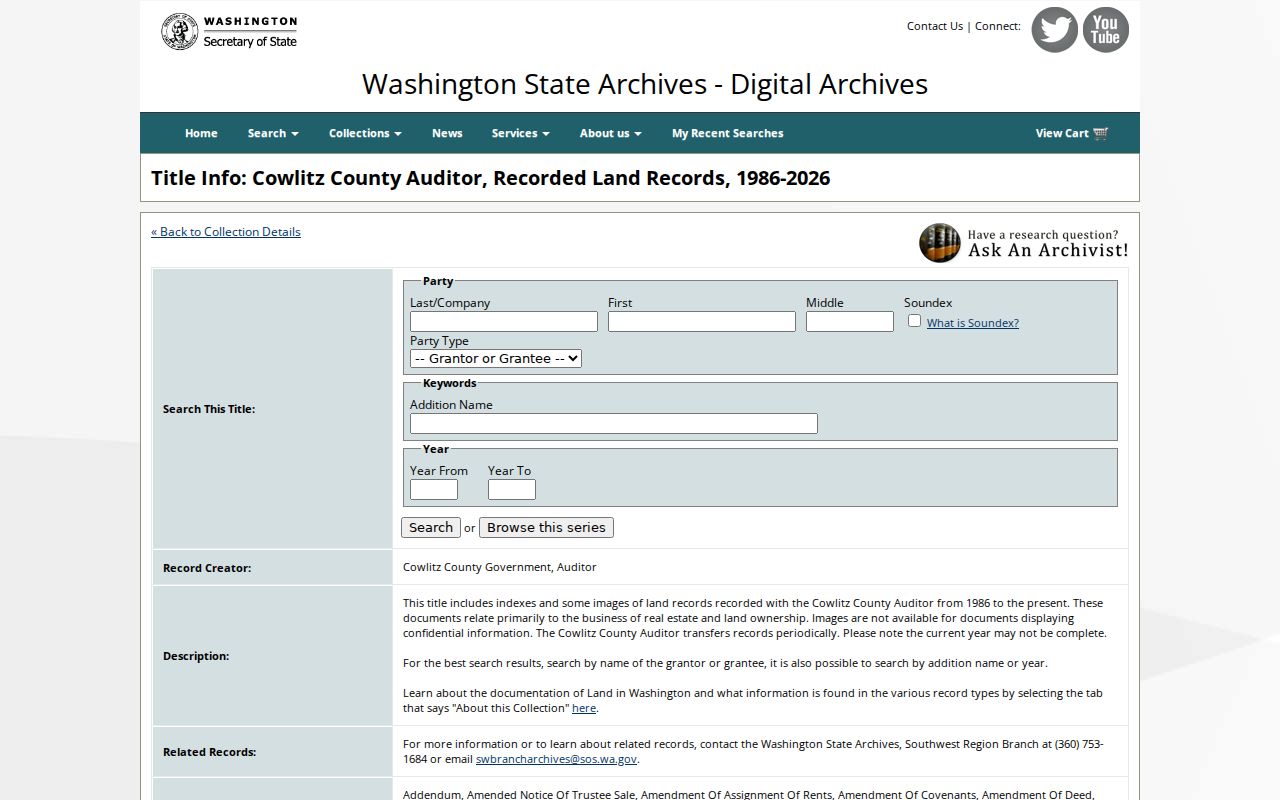
The index image helps distinguish a searchable reference from the deed image that must be read to support a transfer.
Note: The county compares the index to a library card catalog, so a spelling miss or absent scan does not prove no instrument exists.
Walk Cowlitz Deeds Backward
Work from the present owner toward earlier owners one transfer at a time. Do not assume every lien, easement, deed of trust, reconveyance, or trustee-sale notice changed ownership. Read the document type and later instruments before adding a transfer to the Longview previous-resident timeline.
- Copy the current parcel number and site address from the assessor. Use the GIS map to confirm that it is the intended lot.
- Find the current owner's purchase or vesting deed. Record the grantor, grantee, date, document number, and legal description.
- Search that grantor as a grantee in an earlier date range. Try surname variants, Soundex, and the addition name.
- Repeat for each supported transfer. Keep trusts, estates, and businesses labeled as legal owners rather than households.
- For pre-1986 instruments or missing images, take the last solid reference to the Auditor, Archives, or appropriate historical collection.
- Grantor and grantee
- The grantor gives an interest; the grantee receives it.
- Chain of title
- The linked series of recorded transfers for one parcel.
- Legal description
- Recorded lot, tract, addition, or boundary wording that can outlast a street number.
- Vesting deed
- The instrument showing how the current recorded owner took title.
Longview Previous Resident Permit Trail
Deeds show title, while city files show dated contact with the property. The Longview Building Division links current PermitTrax and a historical repository. Search recent files by address or permit number. When nothing appears, request an archive search with the exact address, any former address, parcel number, and a narrow date range. The city says some archived permits and code material reach back to the 1920s.
Keep the roles separate. An owner, applicant, contractor, and inspector are not the same person. Record the permit type, application date, status, and inspection dates only when displayed. An applicant's name places that person in a city transaction, but it does not prove they were among the past residents.
Longview Previous Residents Before 1923
Longview's planned-city origin changes the oldest search. The historic preservation exhibit says 49 owners were approached in 1922, 47 granted options, and many stayed for the first city census in December 1923. The city was dedicated in 1923 and incorporated in 1924. A modern address may therefore begin with a tract owner, plat, or farm description rather than a familiar street number.
Paul Plebuch's tract is the vivid warning. His refusal to sell caused Third Avenue to curve around the land, and the jog remains. Near that alignment, compare the 1923 plat, current GIS shape, addition name, and early Auditor references before matching a modern block to former residents. Physical street form can preserve an older ownership story.
Note: Preserve old spelling and tract language; translating it too early into a modern address can attach the wrong person to the parcel.
Pair Longview Directory Checkpoints
Washington State Library lists Longview inside Kelso directory runs for selected years from 1926 through 2012. The run is not continuous, and the catalog does not provide a complete free page-image set. The State Library directory inventory is the title lead; limited public appointments are available Thursday afternoons after the 2025 access change. Search both place labels.
- Choose the directory year just before and just after a deed or permit date.
- Search the name as printed, then the address section if that volume supports reverse or criss-cross access.
- Record the title, year, page, spelling, address, and whether the entry names a subscriber or listed household.
- Compare the nearest released census or archival census clue, allowing for old boundaries and address forms.
- Label each result by its actual role, and leave an unavailable year as an open interval.
The collection itself, year runs, and reading method belong on the Longview city directories page. Here each edition serves as a dated checkpoint between property events.
Longview Library Fills Gaps
The Longview Library genealogy desk connects the Longview Room, local-history shelves, ContentDM, newspaper microfilm, and the Lower Columbia Genealogical Society. Ask whether a target directory year is local, on microfilm, or available through a licensed database. The library is at 1600 Louisiana Street and the verified phone is 360-442-5300.
Its partial obituary index can lead to a spouse, parent, organization, or address in local newspaper microfilm. A notice is secondary evidence. Verify it against a deed, probate file, certificate, or directory entry. The Cowlitz Historical Museum's PastPerfect material and Washington Archives guide can extend the search through photographs, maps, yearbooks, naturalization files, and Long-Bell records.
See the Longview Library's genealogy and local-history routes. The library provides the local bridge between a directory name and the dated newspaper or archival item needed to strengthen it.
Label Longview Past Households
A careful timeline uses two tracks: documentary ownership and human presence. Mark names as recorded owner, tax-mail recipient, permit applicant, directory-listed person, voter, obituary subject, probate party, or likely occupant. Only the last label is an inference, and it needs more than one dated source. This prevents a trust, estate, distant owner, or contractor from being presented as one of the previous residents.
Probate can close a trail after a death. Search the court index by decedent or estate name, then ask the Cowlitz County Clerk for the official file. Newspapers may fill the span between directories, while FamilySearch's Cowlitz dockets, births, naturalization records, and broader county catalog can add older relationships. End with a source matrix containing date, name, parcel or address, source, citation, and confidence.
Lawful use. Research previous residents for house history, family history, or personal curiosity. Never use an address trail to watch, harass, intimidate, or harm a living person.