
Walk a Longview Street Record
A sound Longview street directory search begins with a full, standardized address. Ownership is public through the Cowlitz County Assessor and recorded deeds, while occupancy needs a separate, dated source. Keep the exact query, result date, and source label. A tax mailing address may belong to an owner, trust, or agent far from the site, so it cannot stand in for who lives there.
- Standardize the address, then search the Cowlitz property application by address. Save the parcel number, site address, listed owner, and mailing address.
- Open the county GIS parcel layer. Confirm the polygon, street frontage, adjoining parcels, and map identifier.
- Use the owner name in the Auditor index. Check deeds, deeds of trust, liens, easements, plats, and reconveyances by date and party role.
- Check PermitTrax and the older city permit repository for dated owner or applicant names. Treat an applicant as an applicant, not an occupant.
- For a past household, ask the library for the closest directory or reverse-directory year and compare the result with a census or obituary.
This sequence moves from address to parcel, owner, legal instrument, and dated household evidence. It is slower than copying one portal result, but each Longview record answers a distinct question.
Before moving on, note whether the site is a house, multi-unit building, business parcel, public facility, or vacant land. That use can change what a name means. A school or industrial tract may have a clear owner but no household to find. A condominium can place many homes on a shared legal structure. When the parcel does not represent one ordinary household, say so and keep the search at the property level.
Search Longview Parcels by Address
The Cowlitz County Property Search is the main address-to-parcel bridge. Its opening controls offer Address, Parcel, and Property ID modes. Start with Address, then preserve the parcel number so spelling, directionals, or a later number change do not break the trail.
| Search route | Input | Best use | Key caution |
|---|---|---|---|
| Address | Street address | Locate a known Longview site | Test standardized variants |
| Parcel | Parcel number | Carry one property across systems | Splits can create successor parcels |
| Property ID | County property ID | Return to a known card | Do not confuse it with an address |
The official assessor screen shows those search modes before a record is chosen.
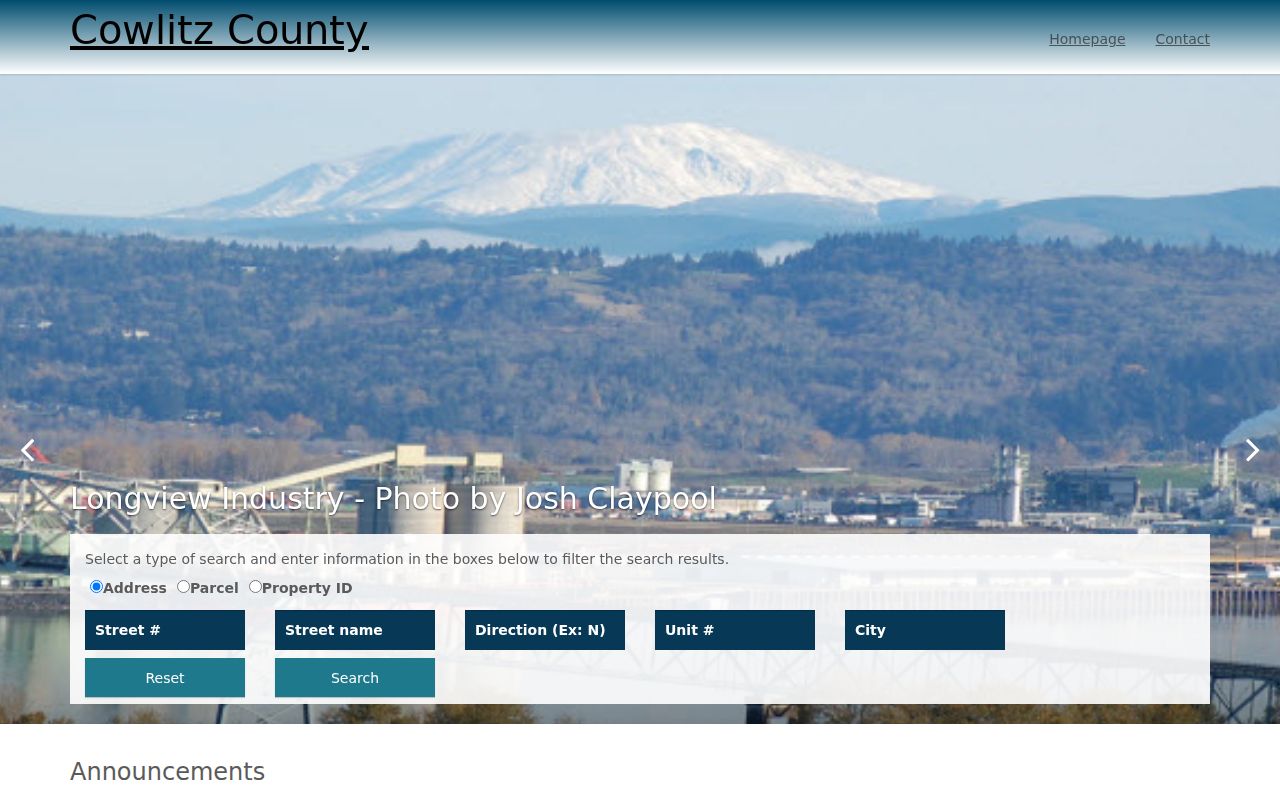
The screen is the starting point, not proof of current residence. Save its return fields with the date searched.
Longview Street Record Terms
Four terms keep an address search precise. They also prevent the common error of treating a map, tax card, and household listing as the same kind of proof.
- Parcel
- A defined unit used for tax and land records; one address may include more than one parcel.
- Situs address
- The physical location assigned to the property, unlike the address where tax mail is sent.
- Plat
- A recorded map of lots, blocks, roads, and easements within a subdivision or tract.
- Criss-cross directory
- A directory arranged by street and house number rather than only by surname.
A Longview street directory becomes more reliable when each fact keeps its record label: GIS geometry, assessor ownership, Auditor instrument, permit applicant, or listed household.
Longview Records Indexed by Street
No official roll identifies every Longview resident. The useful address records cover parcels, recorded instruments, construction, registered voters, or listed households. Search all documented channels, including the counter or records-request route when an online result is missing.
| Record Set | Keeper | What It Shows | Access |
|---|---|---|---|
| Property card | Cowlitz County Assessor | Parcel, owner, site and mailing fields | Online, phone, or office |
| GIS parcel layer | Cowlitz County GIS | Parcel shape and adjoining geometry | Web map or GIS inquiry |
| Recorded instruments | Cowlitz County Auditor | Parties, dates, document types, images | Online index, counter, or request |
| Voter data | Cowlitz Elections or state SOS | Eligible public voter fields | VoteWA or file request |
| Permit files | Longview Building Division | Permit number, date, applicant, work | PermitTrax, archive, or request |
The parcel number ties the current card to the map and often to legal descriptions. A name then opens the deed index. The street address connects permits and publications, but voter data represents registered voters only and protected addresses are withheld.
VoteWA serves personal registration and ballot functions. A broader file request follows the Washington Secretary of State or Cowlitz Elections process and is subject to noncommercial and political-use rules. It is never a complete occupancy roll. The county form may provide defined voter and election-history fields, while state law protects certain addresses. Keep the source date because registration data changes as voters update records.
Follow Longview Deeds by Party
The Cowlitz recorded land-record series covers 1986 through the research date in 2026, though the current year may be incomplete. Search a known owner as grantor and grantee, test Soundex for similar spellings, set a year span, and narrow by deed, easement, lien, plat, or reconveyance. The Cowlitz Auditor counter in Kelso is the fallback for older, missing, or unclear records.
The official deed index displays the land-record search route and document choices. A result names parties to an instrument, not everyone at the address. Open the deed image when available and retain its document number, date, and legal description.
For records not online, call the Auditor at 360-577-3002 or visit 207 N 4th Ave, Room 206, Kelso, Monday through Thursday, 7:00 to 4:30. A focused request names the parcel, parties, document type, and date range.
Longview Permits Date an Address
The Longview Building Division connects an address to building, plumbing, mechanical, planning, and other permit files. PermitTrax handles newer searches by address or permit number. The historical repository can reach back to the 1920s in some cases, so ask for the exact address, former address, parcel, and date span when the live portal stops short.
Permit names describe a role at a point in time. An owner, applicant, or contractor was connected to the work, but that label does not prove occupancy. Code-compliance files may contain sensitive contact details, so make narrow requests and expect lawful redactions. Washington's Public Records Act gives an agency five business days to provide records, link them, acknowledge with an estimate, seek clarification, or deny the request.
Note: City permit records and county property records refresh on different schedules, so record the date used for each Longview address result.
A Longview Street Grid Exception
Longview's planned-city history offers a street-level warning. The historic preservation exhibit says land options were sought from 49 owners in 1922 and 47 agreed. Paul Plebuch did not. Third Avenue curved around his tract, and the jog remains. A straight modern grid is therefore a poor assumption near that alignment.
When lot numbers or street sequences look odd, compare the current parcel geometry with the 1923 plat and early owner names. Search the old tract or addition in the Auditor index, not just the current house number. The physical curve can preserve a land-history fact that a modern street directory entry does not explain.
The same care applies when parcels split or combine. A modern parcel number may not exist in an older deed or permit. Work backward from the current legal description, note each predecessor parcel, and preserve the subdivision or addition name. That chain is more stable than assuming one house number has described the same tract across a century of Longview records.
Old Longview Streets Need Shelves
Historical household evidence lives with the Longview Library genealogy collection, its Longview Room, newspaper microfilm, and the State Library's directory holdings. Reverse or criss-cross arrangement can turn an old address into a listed subscriber or householder. The full collection and year runs belong in the Longview city directories; use the closest available year here only to test one street address.
A directory gap is not proof that a family left. The household may be unlisted, a volume may be missing, or Longview may appear inside a Kelso-titled run. Pair the entry with a census, obituary, deed, or permit before using the name in a street chronology.
Request a Longview Address File
When the online street search ends, choose the custodian before sending a request. The City Building Division holds Longview permit and code files, while the Cowlitz County Auditor holds recorded instruments and plats. The Assessor answers parcel-card questions. Washington Archives may hold transferred Longview city records from 1923 through 1967, including building permits and owners' applications or reports. One broad request sent to the wrong office can be delayed or returned for clarification.
Use the Washington Attorney General's public-records guidance to frame a narrow request. Give the exact current address, any former address, parcel number, record type, and date range. Ask for electronic delivery and for segregable, nonexempt portions if a file contains protected details. Under the Public Records Act, the agency has five business days to provide records or a link, acknowledge the request with an estimate, ask for clarification, or deny it. That response period is not a promise that a large archive search will finish in five days.
Note: Preserve the department, request date, tracking number, and exact address wording so another Longview street search can follow the same path.
Limits of Longview Street Lookups
A property card names an owner for tax work, not each resident. One parcel can hold several units, and the mailing address may point to a trust, business, or out-of-area owner. Voter files omit people who are not registered and shield protected voters. Directories list only the people and households included by that publication. Map lines are approximate and are not surveys.
A search result can also be stale. Assessor cards follow an assessment cycle, deed images may post after an index event, and permit data can sit in a separate historical system. Dynamic voter information changes when registration records are updated. Put an access date beside each finding, keep the official identifier, and verify a recent ownership change with the recorded instrument. If sources conflict, describe both dates and ask the responsible Longview or Cowlitz office for the current record.
Washington's Address Confidentiality Program supplies substitute addresses to eligible survivors, while protected-voter rules restrict exposure. Do not try to defeat those safeguards. When an official result is absent, report the gap rather than guessing who lives at a Longview address.
Lawful use. Use Longview address records only for lawful personal, civic, property, or family-history research. Never use them to stalk, harass, intimidate, or harm anyone.